

December 2016
Fighting Fatigue with Forced Fitness Training
Two recent studies have come out the past two weeks demonstrating against all expectations that the best way to fight fatigue in the face of debilitating disease is by engaging in vigorous physical activity.
Chronic fatigue syndrome (CFS) is a rare but devastating illness of unknown origin. It saps the life out of those who suffer it, making simple chores and enjoyable recreation untenable. It often puts people into such a depressed state of emotional as well as motional being, not just from the disease itself but from the lack of understanding, diagnosis, and sympathy from the medical as well as social and employment arenas.
The Australian researchers wrote in the October issue of Medicine and Science in Sports and Exercise that “patients experience a large exacerbation of symptoms disproportionate to the amount of activity” and studies need to investigate which protocols may work best for these folks. So they compared a group of CFS patients in a cross-over design on energy-matched exercise sessions – one being 20 minutes of continuous cardio, the other being 20 minutes of high intensity interval training (HIIT), the current rage in fitness. This controlled exacerbation allowed them to gage the post-workout effects on subjective markers of fatigue.

Surprisingly, both protocols had similar effects. Heart rates were similar after each but the HIIT routine had a statistically non-significant greater impact on subjects’ levels of fatigue. Whether this could be part of an on-going routine for those with CFS is still unknown.
Cancer patients, during treatment and beyond, often experience fatigue, some for as many as 10 years afterward. Another Australian study reports that bowel cancer survivors (n=52) doing HIIT three times a week for 8 weeks, compared to those doing “moderate intensity continuous exercise”, experienced significantly less fatigue.
How is it that HIIT, the vogue modality in group exercise today, can help those with diseases that produce unimaginable levels of fatigue by creating high levels of fatigue? There is no answer as of now but ultimately the real challenge is getting people to just do it.
Perhaps studies like this will encourage more people at all levels of metabolic and physiologic health to take the one pill that may restore life to their living – exercise.
Resistance Training Helps, Not Hurts, Those with Lymphedema
A few years ago, articles started appearing that showed the fears of breast cancer patients and doctors were largely unfounded when it came to exercise. Lymphedema, a “chronic and progressive issue characterized by the accumulation of fluid…in the arm, shoulder, neck, or torso” of patients and survivors of breast cancer treatment, is caused by the removal or therapeutic disruption of lymph glands in and around the breast(s).
The results of lymphedema range from unsightly and uncomfortable swelling of the limb to feelings of discomfort, heaviness, weakness and disability.
It was believed that exercises that used the arms vigorously enough to generate a strength stimulus could exacerbate lymphedema so doctors were reluctant to prescribe them, especially those that had the arms going above the shoulders. The fear was that impaired lymphatic flow would be challenged by resisted movements that created muscle tension.
A systematic review of the recent literature aimed to summarize the results of studies that met the criteria of the review and to determine if breast cancer survivors could indeed engage in resistance training (RT) at intensities sufficient to elicit gains in strength without exacerbations of lymphedema.

Six studies met the criteria of being high quality, randomized-controlled, with enough subjects to have a control group and obtain reliable results of statistical strength.
One trial found limited evidence that low intensity RT yielded some strength gains in shoulder flexion (raising straight up forward) and abduction (raising straight out sideways) with no adverse effects. Two had strong evidence demonstrating moderate-to-high intensity RT produced greater strength gains without increasing risk of exacerbation. Another found that an RT program was “superior for improving upper- and lower-body strength…compared with a moderate-intensity aerobic [program].” Compared to no exercise, three studies had strong evidence that that moderate-intensity lower-body along with lower-intensity upper-body RT improved strength and didn’t increase risk of lymphedema.
In conclusion, it is safe to say that most patients and survivors of breast cancer treatment could engage in an upper body RT program without fear of exacerbation. One study which didn’t require subjects to wear compression garments found no differences in lymphedema compared to those wearing them. With some simple caveats, fear should be replaced with empowerment if the program is designed and supervised properly by a fitness professional who understands the risks and symptoms of lymphedema.
JSCR Sept. 2016
Recipe of the Month
Easy Migas
Ingredients
5 large eggs
½ teaspoon salt
1 tablespoon olive oil
2 green onions, sliced
2 cups (about 3 ounces) coarsely broken no-salt-added tortilla chips
½ cup mild salsa
½ cup low-fat shredded cheddar cheese
Garnish: 2 tablespoons chopped cilantro and extra shredded cheese
Directions
- Combine eggs and salt in a bowl and stir with a wire whisk; set aside.
- Heat olive oil in a large skillet over medium-high heat. Add green onions and cook for 2 minutes or until they begin to soften.
- Add egg mixture to skillet and cook for 1 minute without stirring, until the edges of the eggs are set.
- Stir in tortilla chips and salsa; cook for 2 minutes or until tortilla chips begin to soften. At this point, the eggs’ texture will resemble traditional scrambled eggs.
- Remove from heat and add cheese; stir until combined and cheese begins to melt. Sprinkle with cilantro and extra cheese, if desired.
Nutrition Information
Serving Size: 1 cup
Calories: 262 Carbs: 17 g Protein: 14 g Total Fat: 15 g
Saturated fat: 3.5 g Cholesterol: 235 mg Sugar: 2 g Fiber: 2 g
Sodium: 696mg Potassium: 253 mg Phosphorus: 248 mg
Exercise of the Month: TRX Single-leg squat
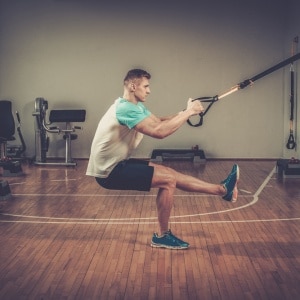
- Begin by grasping both handles of TRX firmly. Lift one foot off the floor.
- Perform single-leg squat by bending your knee to no more than a 90 degree angle with your knee remaining over your ankle. Bend your elbows and pull against handles in order to maintain an upright torso.
- Muscles used: Primarily quadriceps group, glutes, and hamstrings, as well as latissimus dorsi and biceps group. Additionally, torso and hip stabilizers are used to maintain posture.
Tidbits
A multi-center study found that aging takes its toll from toe to head. Seventeen young (18-50 y/0) and 17 older (over 60) people with normal feet were tested with MRI for the size of the toe muscles and with a pressure plate for their strength. It seems that atrophy of foot muscles occurs with age, and the big toe strength correlates with overall toe size…and likely with gait propulsion and balance. JOSPT Dec. 2016
A MRI analysis reported in Cerebral Cortex (Oct. 13, 2016) that women, using virtual reality to “see” their bodies as “obese”, had more brain activity in the parietal lobe and anterior cingulate cortex than men. These areas are associated with body perception and subjective emotion processing, respectively. This suggests that women may be more prone to body image and eating disorder issues than men via body perception and emotional responses to body satisfaction. Duke Medicine Health News Dec. 2016
 Is “Fat but Fit” an Option?