

A recent article in the American Council of Exercise (ACE) on-line newsletter provides a nice synopsis of the value and merits, and techniques, of balance training as a component of overall fitness. I want to address this very current and super-crucial elements of training as I do it here at STEPS Fitness. And sometimes you really should work with a pro.
First of all, I see mostly older and even real-old adults, many of whom have or have had orthopedic or medical issues that may have adversely impacted their balance at some point or even still. Thus, client demands and risks run foremost in my mind when I engage anyone over 60.
Second, in this age group, I assume – rightly or wrongly but still safely – that they have already started down the path toward sarcopenia – loss of muscle mass which starts in your 30s and accelerates after 50 – and osteopenia/osteoporosis in women especially. This ensures that my exercise prescription addresses both issues with an eye toward safety. That is, if muscles are weak, and bones are thinning, then not only do we need to prevent falls but we need to gradually build enough lower body and core strength to enable exercises that demand enough to build bone and balance.
Third, static balance can be enhanced doing static, off-centered exercises in various states of disorientation. By this I mean we can do simple 2-leg stances with feet gradually coming closer together and progressing into off-line stances such as the tandem stance. We can concurrently challenge balance by having the client stand on a squishy surface such as an Airex pad or Bosu or disk. These unbalancing devices should be gradually and safely introduced so that only one challenge at a time is in play. Don’t jump from standing on one foot on the floor to standing on one foot on the disk!
Fourth, I bring in closed-eyes only when a client does not have a condition like vertigo which might lead to nausea or the room spinning. When I do so, I put them near a wall or firm structure – I use the Smith machine to surround them with support systems and I stay right with them, hand above shoulder – so that they can grab on if need be. With any eyes-closed exercise, we progress to less stable stances till we find a ‘break point’ where it’s just not possible.
Fifth, instead of a 2-arm standing exercise like a biceps curl, I’ll do it with one hand, or alternating movement. The weight, as it comes further from the center of mass toward or above shoulder level, has more of a moment arm that could throw the person off balance. Again, progressing from a basic stance to a toe-down, tandem or even one leg stance, on the floor to an Airex pad to a Bosu or disk, and then adding head turns or eyes closed, and now, despite it being a static position, you have moved toward a dynamic balance challenge.
At this point, I want to share with my fellow trainers and potential clients a major point of consideration: being able to balance in extreme stances doing extreme head/eye or arm movements does not confer balance once you start walking, let alone walking on uneven surfaces or distracting conditions like a mall during Christmas. No matter how challenging the static balance drill is, once you lift one foot off the floor and start moving, all bets are off.
So at some point we move toward dynamic or moving balance. Typically this starts with walking, adding challenges along the progression: head turned, one line, over or around objects as if on an obstacle course, an agility ladder, etc. We can also add eyes closed if you can ensure safety, arm movements – one arm curls or lateral raises increase laterals stability demands, and cognitive challenges such as counting backwards from 100 by 7s. (Note – some folks are terrible at simple math so may do better with saying the alphabet backwards or saying a word that begins with each letter of the alphabet as they walk.)
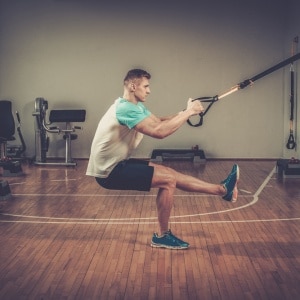
For athletes or athletic types, dynamic balance challenges can include such things as ball throwing, hand switching of a dumbbell or med ball, and combinations of head, eye, one-arm, leg position – like hip flexed and hold or what I call a model’s gait, or drunk gait, where you flex the hip and cross the line you’re walking, etc.
In general, creativity is wide open so long as safety remains paramount. I know it sounds like I’m dealing with delicate elders but, hey, I am. One fall, one broken hip or shoulder and not only do you lose a client, you lose your reputation.
Several years ago I was working with an elderly woman with Parkinson’s. I had her walking laterally and not with an elastic band around her legs; just stepping to the side. I even told her not to let her feet get close together since that’s a dangerous position. However, being both cognitively slower and neuromuscularly slower, she not only let her non-lead foot come to the lead foot, but when she lost her balance she fell backwards. The sound of a live human head hitting a rubber-coated concrete floor is sickening. We got her to her doctor who ordered an MRI. She was ok, but I was miserable.
My point is, when playing with balance challenges, trainers and clients need to be aware that gravity works at a remarkably high rate of acceleration. The margin of error is narrower for people who are weaker, less coordinated, slower by virtue of age or disease, and more fragile too.
The lead-in article is excellent for its advice but consider that little was mentioned of how to implement balance training safely. Remember, first do no harm.
 REAL News – July 2019